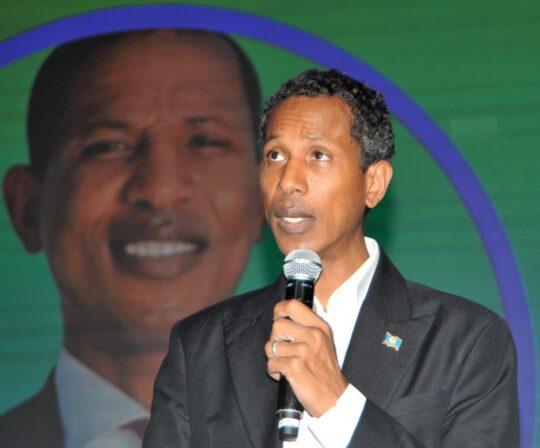
Dr. Moses "Shyne" Barrow
Belizean Political Leader Dr. Moses “Shyne” Barrow Encourages Caribbean Leaders to Invest in Culture
Written by: Overtime Media
Belizean political leader and hip hop legend, The Honourable, Dr. Moses “Shyne” Barrow has identified Jamaica as a regional blueprint for how culture and governance can work together to build sustainable industry.
Delivering a keynote address titled ‘From Stage to State’ at the Island Music Conference (IMC) in Kingston, Jamaica last week, Barrow urged Caribbean governments to move beyond symbolic support of the arts and toward structured public–private partnerships.
“These conferences are so very important,” he told delegates, describing information exchange as critical in an evolving global music economy.
Responding to a question from Overtime Media about cultural influence as an economic engine, Barrow pointed to Jamaica’s global footprint.
“The work of great musicians such as Bob Marley and Shabba Ranks, as well as the development of Reggae and Dancehall music, has done more for the Jamaican tourism product than anything else,” he said.
According to Barrow, Jamaica exemplifies how successive political administrations, despite partisan rivalry, maintained consistent implementation policies that enabled private-sector investment in the music industry.
“They were fighting each other, but giving the same implementation,” he noted, crediting that alignment for helping Jamaican music achieve unmatched global recognition.
“There is no one in the world who does not know about Jamaica — its music, its food and its culture,” he declared.
Barrow framed his own political evolution as rooted in hip hop’s entrepreneurial DNA. Calling his transition from performer to legislator “quintessential hip-hop,” he cited moguls who expanded beyond music into business and influence, arguing that creative thinkers belong in positions of power.
“We belong in Parliament. We belong in the Cabinet. We belong in the Prime Minister’s office and in the President’s office,” he said.
He also addressed emerging challenges facing the creative sector, particularly artificial intelligence and intellectual property protection.
“We need to protect our rights. We need to protect our work and that can only be legislated,” Barrow warned. “If we don’t get involved in the legislative process, we’re going to wake up one day and find that our rights are gone.”
Calling the human mind “the greatest thing on planet Earth,” he cautioned against overreliance on technology, stressing that creatives must remain central to innovation.
Reflecting candidly on his past — including a decade of incarceration following a 1999 nightclub shooting — Barrow described his return to Belize as a shift toward service.
“By then, my dreams had already come true,” he said. “But when I looked around my country, I saw people still struggling. So I chose a life of service.”
Barrow also revealed plans to return to the stage with a world tour marking the 25th anniversary of his debut album, while reaffirming his commitment to public service.
Closing his address, he challenged Caribbean leaders to diversify the profiles of those shaping legislation.
“The Caribbean’s creative class has already shaped global culture,” he said. “Now we must shape policy.”
Most Popular Posts

Terri Lyons Is Calypso Royalty
By: Nekisha CyrusHands down, Terri Lyons is one of the most dynamic vocalists in the game with the musical versatility to match. Even though she hails from soca royalty as daughter of a soca legend, the one and only Super Blue, she has been determined to create her own legacy in the music industry
Read more ...
Spice: Colorism and Black Hypocrisy
By: Charmaine LindsayJamaican, Dancehall artist Spice, whose real name is Grace Hamilton is most popular for her erotic songs, and music videos with her acrobatic female dancers. However, she took a break from that routine to speak out against colorism. She did this in her recent social media stunt, and soon after released single, “Black Hypocrisy”.
Read more ...
Mas Legend, Peter Minshall Returns for Carnival 2020
By: Nekisha CyrusPeter Minshall will be returning to the Trinidad Carnival scene in 2020 as a band mas-designer. No stranger to controversial art, the recent unveiling of his new collection ‘Mas Pieta’ was inspired by Michelangelo’s renaissance sculpture, ‘The Pieta’.
Read more ...
Big Rich In The Pungalunks Factory
By: David LawrenceBehind the signature phrase ‘Big Rich in the Pungalunks Factory’ which is heard in songs like Hunter’s ‘Jep Sting Naina’, Hunter’s and Bunji Garlin’s ‘Bring It’, and Kenneth Salick’s ‘Radica’, is an interesting story of human ingenuity that beckons to be told.
Read more ...